|
By Ann Hauprich
The executive director of the American Italian Heritage Museum and Cultural Center is living proof that one needn’t don shining armor for knightly qualities to shine though.
The retired university professor officially earned the title “Cavaliere” -- which means “mounted soldier” in Italian -- when he was knighted by the government of Italy for decades of service to the Italian-American community.
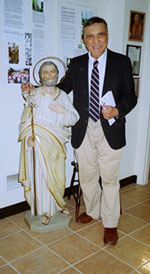 Prior to working feverishly to recruit volunteers and raise funds to establish the American Italian Heritage Museum and Cultural Center, Professor/Cavaliere DiNovo conceived the idea of an Italian American Cultural Association for the purpose of recording and preserving the Italian heritage and culture in the USA. Prior to working feverishly to recruit volunteers and raise funds to establish the American Italian Heritage Museum and Cultural Center, Professor/Cavaliere DiNovo conceived the idea of an Italian American Cultural Association for the purpose of recording and preserving the Italian heritage and culture in the USA.
This year marks the 30 th anniversary of the founding of the IACO, which grew from a seed the Albany, NY native first planted in the minds of a handful of others while teaching college in Utica in the 1970s into an international organization with members in 36 states and four countries.
The first in his family ever to attend college, Professor/Cavalier DiNovo is also member of the Italian American Folk Art Council who has written for numerous Italian-American publications across the nation.
Having grown up during a time in the nation’s history when those with Italian roots were often treated as second class citizens, the distinguished executive director lights up when he sees visitors like
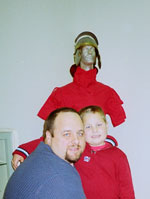 Anthony Pennacchio and his
five-year-old son A.J. (Anthony) enter the museum. Anthony Pennacchio and his
five-year-old son A.J. (Anthony) enter the museum.
“A.J.’s great-grandfather and great-uncle were honored in Genova, Italy for their contributions to our heritage. I want my son to grow up feeling proud of his ancestors,” said Mr. Pennacchio. Altough it was clear to see that A.J. found many exhibits to be of interest, his all-time favorite was decidedly one depicting an ancient warrior’s helmet.
While too young right now to appreciate all of the sacrifices that led to the life he and others of Italian descent enjoy in America today, A.J.’s father plans to bring him back again when he is older so he can learn as much as possible about those whose lives and legacies are commemorated within the walls of the museum and cultural center.
Many older visitors are fascinated to learn that the complex that now houses the heritage museum and cultural center was originally a church attended primarily by devout Roman Catholic Italian immigrant families, according to Professor/Cavaliere DiNovo.Noting that many were initially sad when the mission style church known as Our Lady of Mercy Church at 1227 Central Avenue closed its doors half a century ago so parishioners could move to a larger church, he is convinced that “God’s hands have guided this place every step of the way.” Built in the 1920s as a house of worship in what was then considered West Albany wilderness, the historic structure continues to glorify God by preserving religious, historic and cultural gems for posterity. “This is a real life example of what Christ meant when He said: ‘Unless a grain of wheat falls to the ground, it remains just a grain of wheat. But if it dies, it will produce much fruit,’ reflects Professor/Cavalier DiNovo. “This museum has the perfect home today because its life as a church came to an end when its walls were no longer large enough to hold the growing parish family.”
Among the others who recently visited the American Italian Heritage Museum and Cultural Center was Sister Mary Jane Manzerra who expressed joy at the newfound use of the church where Sisters of Mercy taught catechism lessons in an upstairs area until Our Lady of Mercy School opened its doors in 1958.
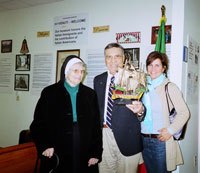
“I think it’s delightful that the church is being used for a good purpose,” said the retired nun whose parents came from Avalina and Malta Leone in Italy.
“It is important for people – especially the younger generation – to learn about the struggles of those who came to this country when Italians weren’t exactly given an open arm welcome. Italian immigrants took the back seat so to speak and often lived in the alleys – but those alleys were immaculate,” recalls Sister Mary Jane, adding: “Being here today has brought back many of the stories my parents told me that I had forgotten.”
Despite their clean living and devotion to God, noted Sister Mary Jane, many Italians were persecuted and experienced discrimination and religious bigotry firsthand. “You can see the hardships as you look at the expressions on the faces of the immigrant families in the photos on the walls of the museum,” she notes.
The faces to which she makes reference are found in first-floor exhibits that bear such titles as “The Immigrant Story”, “Italian American Families”, “Faith of Our Ancestors” and “Hall of History.”
One of the most poignant displays tells the story of Italian immigrants with photos and artifacts such as traveling trunks and suitcases of bygone eras. Other images capture Italian Americans tending gardens and helping to build landmarks ranging from mansions and churches to railways, subways and canals.
Also showcased within the museum’s walls are Italian-made tools, china, pottery, jewelry, hand-made lace, embroidery and hand-carved artifacts, including dolls and a rosary crafted fashioned from olive pits. The facility also offers a newsletter, cultural programs, outreach programs and activities that are designed “to enhance, highlight and extend the Italian heritage, history and culture to the public.”
Poet and photographer Serafina Cifarelli Wellen, who was born to Italian immigrant parents, remembers being told to stop speaking Italian and not to carry a camera in public after World War Two broke out because of fears of the family might be falsely accused of being spies and placed in an interment camp. After growing up hiding her Italian ancestry, Wellen finds it healing to work as a volunteer at the AIHMCC where she can play an active role in educating others of about her ancestors’ history, heritage and culture.
Retired social worker Bernadette Ambrose, whose grandparents’ arrived in the USA with the last name D’Ambrosio, but were advised by an official against keeping what he referred to as “that WOP name.” Says she also hopes parents and teachers will bring young minds to the museum.
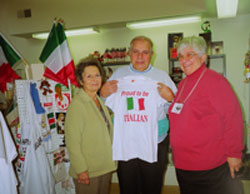 Andrew Giovannone, who came to the USA from Naples in 1963 at the age of 20. is thrilled that the traditions of his boyhood are being preserved for future generations. Andrew Giovannone, who came to the USA from Naples in 1963 at the age of 20. is thrilled that the traditions of his boyhood are being preserved for future generations.
“I regret that I never taught my sons to speak Italian, but that’s the way it was in those days. I am happy to be given a chance to help share the story of my homeland with others through the museum,” he smiles.
Visitors clearly feel the same upon interacting with Mr. Giovannone – who demonstrates with ease that laughter has no accent!
|